




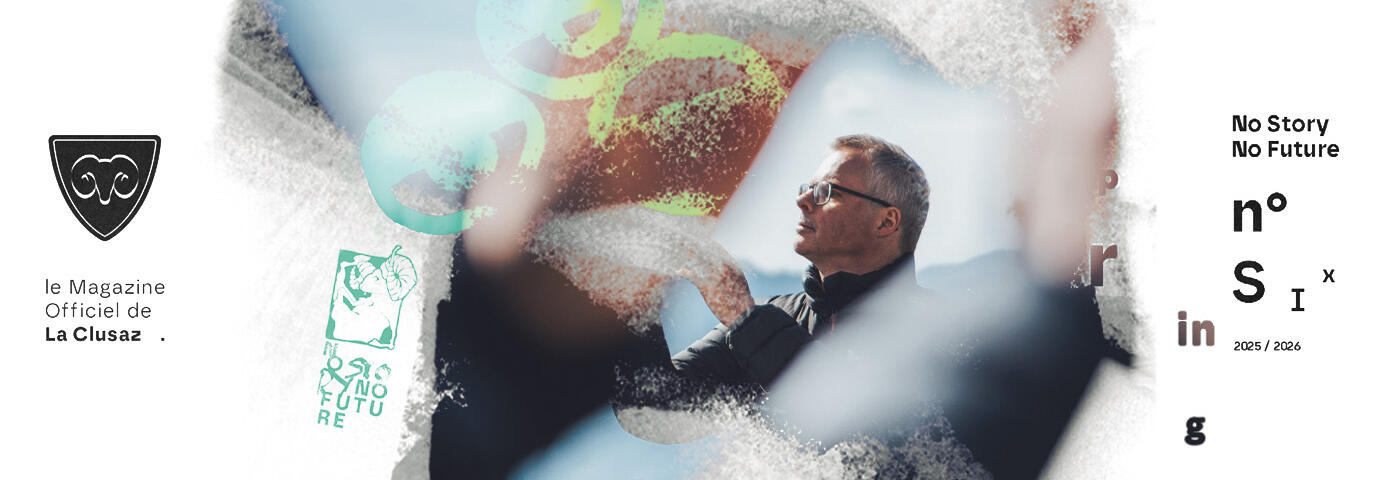
Behind the scenes of the Aravis music scene, we find Lionel Rivière. A conductor, teacher and composer, for the last ten years he has directed the La Clusaz Harmony Orchestra, L’Echo des Aravis, as well as the inter-community music school. Originally from Picardy and trained in Paris, he has found the mountains the perfect place to express his love of collective music and off-the-wall projects.
Did you always want to make music?
Yes, from the age of seven or eight. Nobody in my family did music, but I knew that I wanted to be a musician. I mainly play brass, the horn, a bit of piano, percussion at one time, and I compose a lot.
As far as the Harmony Orchestra is concerned, you are very involved in the Aravis school. What is your role?
I have several roles, but the first is definitely to bring people together. I often say that the orchestra is a mini society: there are around 60 musicians, from 13 to 77 years of age. My job is to bring everyone together to work on projects, to find a repertoire that appeals to everyone, to help them discover new things, to organise rehearsals and concerts and bring the orchestra to life in the best possible way.
What is the orchestra’s philosophy?
The harmony aspect is all about versatility: ceremonies, carnivals, innovative projects. I often say: you have to be the best in everything, in different repertoires. In La Clusaz, our strength lies in our desire to innovate, to meet new artistes and to create.
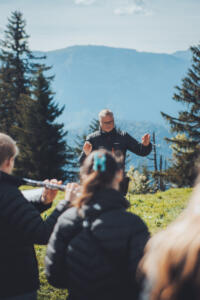
Are rehearsals a serious business or happy chaos?
It’s not military, nor is it happy chaos! Red wine and Reblochon cheese are for afterwards, and it’s sacred. During rehearsals, we knuckle down and work. It’s not strict, but there are certain requirements, and the musicians are there to progress.
Tell us about Harmonie Mécanique. How did it come about?
It’s a meeting between the La Clusaz Harmony Orchestra and an artist I’ve known for a long time, Jonathan Mathis, through the barrel organ. We’d already worked together more than 20 years ago, and then we thought: what if the two of us put together a whole concert combining a barrel organ and 60 musicians? We did the show for the first time at Christmas 2024 and really enjoyed it. So, we’ll be playing it again several times over the coming year. It was a project close to our hearts and it was easy to get the whole team on board.
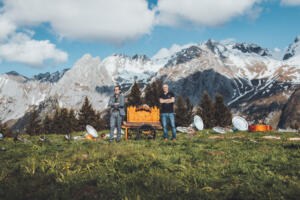
In practical terms, what was the most complicated thing?
Definitely the writing. Creating original, accessible, coherent music for the organ and the orchestra. We wrote an hour’s worth of music, rehearsed separately and put it all together last September. And that’s when we knew it was going to work.
You’re also a teacher. Can you tell us about your role and how the Aravis School of Music works?
The Aravis School of Music has 150 students from La Clusaz, Le Grand-Bornand, Saint-Jean-de-Sixt and Manigod. My role is to teach music to as many children as possible and to nurture harmony orchestras. We have 14 part-time teachers, each in a different discipline. The aim is to practise together, to get the students to play together. We explore all styles of music to arouse their curiosity.
Do children still dream of playing the horn?
I’m a horn teacher, so I’d have to say they do! Of course, there are still plenty of children who dream of playing the clarinet, horn, accordion or organ. Children have no preconceptions; they’re very open-minded. Which instrument appeals most? Percussion instruments, without a doubt! We even have to have a waiting list for that.
Can you explain what school orchestras are?
Yes, it was set up four years ago with four town councils in the Aravis area. The idea is for entire classes, in the last three years of primary school, to become an orchestra. Today, we have 11 school orchestras – that’s huge! It’s thanks also to the support of the Haute-Savoie council which helps us to buy the instruments. All the children play for an hour and a quarter a week, during school time. Even school teachers play with their pupils. They’re not always the most disciplined! But they’re getting into it and that’s great.
There’s been a lot of talk about the Aravis Electro Kids Orchestra project this year. Can you tell us more?
The idea was to create something innovative, bringing together 220 children with a DJ and electronic music. Bertrand Boulot, who works in schools, co-created the pieces with me. We played on Radio Meuh. The aim is for children to keep this memory for the rest of their lives. Next year, we’re planning another project with the school orchestras and Bertrand: the children will be playing live music to animated films. Each village will have its own end-of-year concert at the cinema.
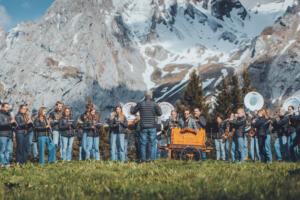
Are these slightly out-of-the-ordinary projects what you prefer at the end of the day?
Yes, I’m really passionate about crazy, offbeat projects. Working with artistes is always rewarding and it pushes everyone to do their best. We have a number of interesting projects in the pipeline, including a musical trip around the world for Christmas and a project on gypsy music with an accordionist and a violinist.
Can you tell us about the most offbeat project you’ve ever worked on?
I’d say it was in Picardy with 40 brass and percussion instruments, 4 bagpipes, 4 Breton bombards and 4 Celtic snare drums. We played in the official programme at the Inter-Celtic Festival of Lorient, with around ten performances and a record that sold 2000 copies. It was a crazy year with concerts everywhere and great musical and human journeys.
A last word?
Just to say thank you. All this exists thanks to the support of La Clusaz town council, the tourist office, the Haute-Savoie département, the Thônes Valley community of municipalities (CCVT), the Aravis Massif intermunicipal syndicate (SIMA) and each village. We’re well supported and that’s what makes it all possible.